STUDY RESOURCES
Comprehensive resources for astrophysics, computational modeling and mathematics.
This section brings together a curated collection of study notes, references, and learning resources developed throughout my academic journey in astrophysics, computational modeling, and mathematics. While primarily intended for my own academic development, they are shared here in the spirit of open learning and collaboration.
Astrophysics
Theoretical modeling of stellar and galactic systems.
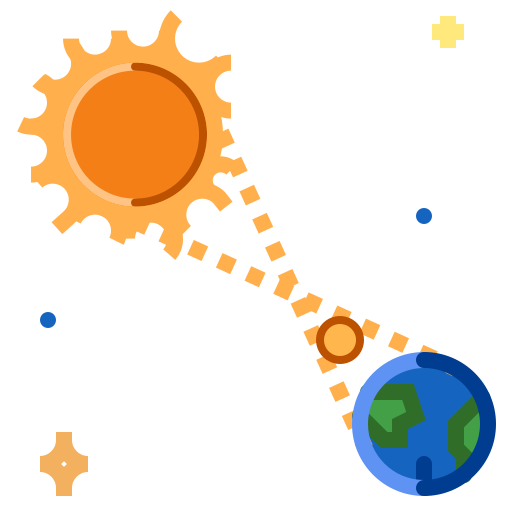
Eclipse Geometry
This note explores how eclipses occur, the conditions required for their alignment, and how geometry, orbital inclination, and shadow formation determine their types and visibility.

Analemma Geometry
Here we examine why the Sun traces a figure-eight or teardrop pattern in the sky, linking Earth and other planet’s axial tilt and orbital eccentricity to seasonal time variations.
.png)
Kepler's Equations
This section breaks down the meaning of Kepler’s equation, why it cannot be solved analytically, and how numerical methods are used to describe orbital motion and explore intuitive problems.

Classical Dynamics of Inflation
This section explores the classical dynamics of cosmic inflation, the big bang puzzles, and the inflation including the role of scalar fields and the evolution of the universe's expansion rate.
Mathematics
Numerical foundations for a better understanding of the universe.

Fourier Analysis
Exploration of Fourier transforms for analyzing periodic signals in astrophysics, signal processing, and spectral density estimations.

Bayesian Inference
Probabilistic methods for astrophysical parameter estimation, model selection, and MCMC simulation foundations.
Data Science
Machine learning architectures for scientific computation.

Learning Astroquery
This note explores how Astroquery is used to access and retrieve astronomical data from online databases and contain notebook with github links to show more implications.
Miscellaneous
Supplementary materials and academic typesetting.
Sky Observation
Explore the night sky, identify stars, constellations, and planets, track celestial events, estimate brightness and angles, use star charts and instruments, and build hands-on observational skills for astronomy and competitions like IOAA.